Back To Blogs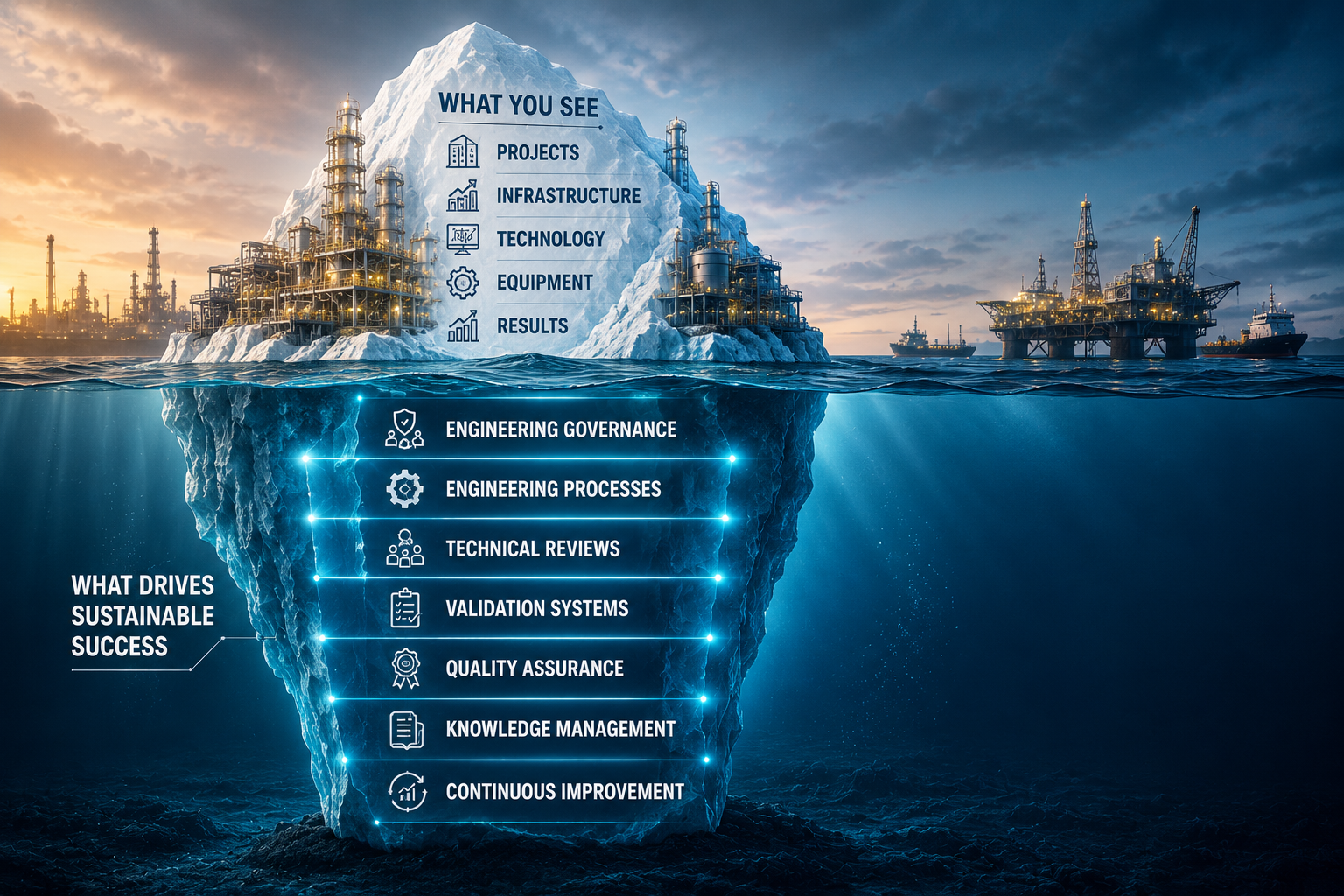
Hidden Systems Behind Industrial Engineering Success.
Walk into two engineering organizations with similar infrastructure, comparable resources, and equally qualified engineers.
One consistently delivers projects on time.
Maintains high quality standards.
Minimizes rework.
Controls risk effectively.
Builds long-term client trust.
The other struggles with delays, design conflicts, quality issues, execution bottlenecks, and rising project costs.
What creates the difference?
The answer is rarely technology.
It is rarely budget.
And it is rarely manpower alone.
The true differentiator lies beneath the surface.
It lies within the hidden systems that govern how engineering organizations operate, collaborate, validate, execute, and continuously improve.
Across Oil & Gas, Petrochemical, Refinery, Energy, Water Treatment, Offshore, Marine, and Industrial Manufacturing sectors, the highest-performing engineering organizations have one thing in common:
They have engineered their engineering processes.
Engineering Excellence Is Never Accidental
Many organizations believe success is driven solely by technical expertise.
While technical knowledge is essential, expertise without systems often creates inconsistency.
High-performing organizations understand that sustainable success comes from creating environments where engineering excellence becomes repeatable.
Rather than relying on individual brilliance, they build systems that allow teams to consistently perform at a high level.
These systems create:
- ✔ Predictability
- ✔ Accountability
- ✔ Quality
- ✔ Scalability
- ✔ Continuous Improvement
Hidden System #1: Engineering Governance Frameworks
Top-performing organizations establish clear governance structures.
Every major engineering decision follows defined pathways.
Responsibilities are clear.
Approval authority is established.
Design ownership is documented.
Technical accountability is maintained.
Governance creates consistency regardless of project size or complexity.
Strong Governance Enables:
- Faster decision-making
- Better accountability
- Improved quality control
- Reduced technical ambiguity
Organizations without governance often depend on individuals.
Organizations with governance depend on systems.
Hidden System #2: Structured Engineering Processes
Engineering success depends heavily on process discipline.
High-performing organizations do not leave execution to chance.
They create structured workflows for:
- Requirements management
- Engineering design
- Technical reviews
- Validation activities
- Documentation control
- Project delivery support
Standardized processes improve consistency across teams and projects.
They reduce variability and improve predictability.
Hidden System #3: Cross-Disciplinary Collaboration Models
Industrial facilities are complex systems.
Mechanical engineering affects process performance.
Instrumentation influences control reliability.
Electrical systems impact operational continuity.
The strongest organizations create integrated collaboration models that connect:
Engineering Disciplines
- Mechanical Engineering
- Process Engineering
- Electrical Engineering
- Instrumentation Engineering
- Automation & Control Engineering
- System Integration
Collaboration prevents silos and improves overall project quality.
Hidden System #4: Validation Before Execution
Leading engineering organizations understand a critical principle:
The cheapest place to find a problem is before construction begins.
Validation systems help identify risks before they become costly issues.
Validation activities often include:
- Design verification
- Simulation studies
- Technical reviews
- Compliance checks
- Risk assessments
- Interdisciplinary evaluations
Organizations that validate early execute more effectively later.
Hidden System #5: Knowledge Management
Many engineering organizations lose valuable knowledge after project completion.
Top-performing organizations capture, retain, and reuse technical knowledge.
They maintain:
- Lessons learned databases
- Technical libraries
- Engineering standards repositories
- Best practice documentation
- Project reference archives
Knowledge becomes an organizational asset rather than an individual asset.
Hidden System #6: Quality Assurance Culture
Quality is not a department.
It is a culture.
High-performing organizations embed quality into every engineering activity.
Quality systems typically include:
✔ Technical reviews
✔ Document controls
✔ Revision management
✔ Compliance monitoring
✔ Engineering audits
✔ Validation procedures
Strong quality cultures reduce errors and improve long-term reliability.
Hidden System #7: Continuous Improvement Programs
Engineering excellence is never static.
The best organizations continuously evaluate:
- Process performance
- Engineering outcomes
- Project execution metrics
- Client feedback
- Operational results
Continuous improvement creates a cycle of learning and optimization.
Over time, this compounds into a significant competitive advantage.
The Engineering Performance Multiplier Effect
Each hidden system provides value independently.
However, the greatest impact occurs when these systems work together.
Governance improves decision quality.
Processes improve consistency.
Collaboration improves integration.
Validation reduces risk.
Knowledge management improves learning.
Quality systems improve reliability.
Continuous improvement strengthens performance.
Together they create a multiplier effect that drives engineering excellence.
Why Competitors Often Cannot Replicate Success
Technology can be purchased.
Infrastructure can be expanded.
Equipment can be upgraded.
Hidden engineering systems are different.
They require:
- Leadership commitment
- Process discipline
- Organizational maturity
- Continuous investment
- Cultural alignment
This is why high-performing engineering organizations often maintain their advantage for years.
Their success is embedded within the way they operate.
Industrial Success Begins with Engineering Systems
Organizations frequently focus on visible assets:
- Facilities
- Equipment
- Software
- Resources
Yet the most powerful competitive advantages are often invisible.
The systems that govern engineering performance ultimately determine:
✔ Project quality
✔ Delivery speed
✔ Operational reliability
✔ Risk management
✔ Long-term profitability
The strongest engineering organizations do not simply engineer projects.
They engineer the systems that deliver projects.
Frequently Asked Questions (FAQs)
1. What makes some engineering organizations more successful than others?
Successful organizations build structured governance, engineering processes, quality systems, validation frameworks, and continuous improvement programs.
2. Why is engineering governance important?
Governance creates accountability, consistency, decision control, and quality assurance across engineering activities.
3. How do engineering systems improve project outcomes?
They reduce variability, improve collaboration, strengthen validation, and increase predictability.
4. What role does knowledge management play in engineering?
Knowledge management preserves lessons learned and best practices, helping organizations improve future project performance.
5. Why is validation important before execution?
Validation identifies risks and technical issues before they become costly construction or operational problems.
6. How does continuous improvement support engineering excellence?
Continuous improvement helps organizations learn from previous projects and optimize future performance.
7. Can engineering systems become a competitive advantage?
Yes. Mature engineering systems often create sustainable advantages that competitors find difficult to replicate.
Why Petronash Engineering?
At Petronash Engineering, we believe exceptional engineering outcomes are driven by exceptional engineering systems.
Our engineering methodologies combine governance, validation, quality management, technical expertise, and continuous improvement to deliver predictable industrial results.
Why organizations partner with Petronash Engineering:
✔ Structured engineering governance frameworks
✔ Proven engineering processes and methodologies
✔ Strong quality and validation systems
✔ Cross-disciplinary engineering expertise
✔ Focus on execution reliability and risk reduction
✔ Knowledge-driven engineering culture
✔ Continuous improvement mindset
✔ Commitment to long-term industrial value creation
Ready to Build Stronger Engineering Systems?
Whether you are looking to improve engineering performance, strengthen governance, reduce project risk, or accelerate industrial growth, our engineering specialists are ready to support your objectives.
📩 Email: [email protected]
🌐 Website: www.petronashengineering.com
Partner with Petronash Engineering and discover how hidden engineering systems can transform project outcomes, strengthen reliability, and create lasting industrial success.
Recommended Hero Image Concept
For this blog, create a 3D industrial iceberg model:
Visible Above Water:
- Projects
- Infrastructure
- Technology
- Equipment
Hidden Below Water (larger section):
- Governance
- Processes
- Validation
- Quality Systems
- Knowledge Management
- Collaboration
- Continuous Improvement
Title in image: "The Hidden Systems Behind Engineering Success"
This visual is highly unique, memorable, and perfectly aligned with the article's core message.