Packages

Chemical Dosing Package

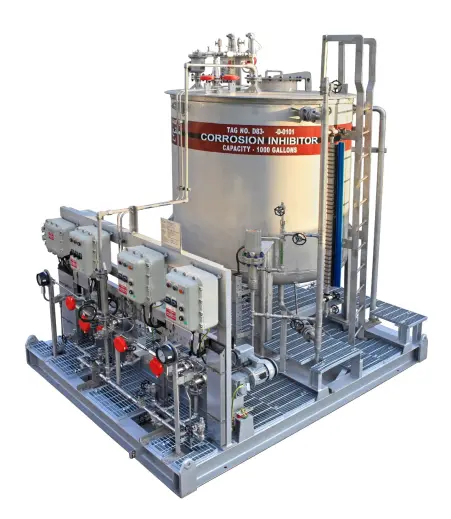
Chemical dosing or injection package or dosing system comes with basic configuration such as Chemical injection tank, pumps, valves and instrumentation, associated piping & electrical controls.

All these equipment are mounted on the single skid frame. These dosing packages are widely used in onshore and offshore applications for injecting various chemicals at required pressure and flow rate.

Petronash also offers other types of dosing packages such as Multi-Point Injection, multi compartmental, package for subzero temperature, solar powered, etc.,

Features

  • Modular steel structure with drip tray for collecting the spillages
  • Painting or galvanizing as per customer specifications
  • Chemical storage tank as per ASME Section VIII Div 1 (with or without U stamp), API 650, UL142 and other international standards
  • Dosing pumps as per API 674 and API 675 standards with local as well as remote stoke control
  • Instruments and control systems (PLC or DCS) as per customer needs
  • Optional special features such as solar operated, mobile type, completely insulated for extreme temperatures conditions, etc.,

Applications

  • Corrosion and scale inhibitor
  • Oxygen Scavenger
  • Fuel Additives
  • Methanol injection
  • Disinfection & pH control
  • Other applications in Oil & Gas, Refinery, food processing, water treatment, etc.,
Request A Quote
package

FAQ

A standard Petronash chemical dosing package includes:

  • chemical injection tank
  • dosing/injection pumps
  • suction and discharge piping
  • valves and fittings
  • pressure gauges, flow indicators, transmitters
  • calibration pot (optional / recommended)
  • control panel with PLC/DCS interface (as required)
  • skid frame with drip tray

Everything is mounted on one skid to ensure easy installation and quick commissioning.

Both terms are often used interchangeably. In general:

  • Chemical dosing package refers to controlled chemical supply, usually for continuous dosing
  • Chemical injection system is commonly used in oil & gas for pressurized injection into process lines, pipelines, and wells

Petronash packages are designed for both dosing and injection applications based on required flow and pressure.

Petronash chemical dosing packages are widely used in:

  • onshore oil & gas fields
  • offshore platforms
  • refineries and petrochemical plants
  • water and wastewater treatment plants
  • power plants and process industries

Skid-mounted designs simplify offshore installation and reduce field fabrication work.

Petronash dosing packages are commonly used for injecting:

  • corrosion inhibitors
  • scale inhibitors
  • oxygen scavengers
  • methanol (hydrate inhibition)
  • biocides / disinfectants
  • pH control chemicals
  • fuel additives
  • and many other process chemicals

Chemical compatibility and material selection can be customized as per fluid properties.

Petronash dosing packages integrate pumps designed as per:
API 674 (for reciprocating pumps)
API 675 (for controlled volume metering pumps)

Stroke control can be provided:

  • locally (manual)
  • remotely (automatic / control system)

This ensures the package meets oil & gas and EPC specifications.

Petronash offers chemical tanks designed as per multiple standards depending on the application:
ASME Section VIII Div 1 (with or without U-stamp)
API 650
UL 142
and other international standards on request.

This makes the package suitable for global project requirements.

A multi-point injection package is designed to inject chemicals at multiple injection points from a single skid. It is used when:

  • one chemical needs to be injected into multiple pipelines or process lines
  • multiple wells/pipes require separate injection control
  • different injection rates are needed at different points

Petronash provides multi-point injection with proper metering, isolation, and safety instrumentation.

Yes. Petronash offers special packages for harsh environments such as:

  • subzero temperature chemical injection skids
  • completely insulated packages
  • temperature-controlled enclosures and heating solutions

This ensures chemical flow stability and prevents issues like viscosity rise or freezing.

Petronash provides control and automation systems such as:

  • PLC control panel
  • DCS interface compatibility
  • local and remote pump control
  • alarm and shutdown interlocks
  • instrumentation for flow, pressure, level, and safety monitoring

The control philosophy can be configured as per client standards and project requirements.

Petronash chemical dosing skids include:

  • modular skid structure with drip tray to collect spillages
  • proper chemical containment layout
  • standard safety instrumentation options
  • isolations and pressure relief design as required

This makes the package safe for offshore and hazardous area operations.

Yes. Petronash offers multiple specialized chemical dosing package designs such as:

  • solar operated packages
  • mobile/skid mounted portable units
  • multi-compartment tanks
  • fully customized systems for specific chemical and performance requirements

This helps meet project constraints such as remote sites, energy limitations, and space constraints.

Petronash chemical dosing packages are trusted because they offer:

  • complete skid-mounted design for fast installation
  • API compliant dosing pump integration (API 674 / API 675)
  • chemical tank compliance as per ASME / API 650 / UL142
  • strong automation options (PLC/DCS)
  • customization for offshore and extreme environment needs

Petronash focuses on reliability, compliance, and long-term field performance.

Yes. Petronash can deliver packages with:

  • customized painting/galvanizing
  • customer documentation and inspection requirements
  • special materials for corrosion resistance
  • instrumentation as per project preferred brands
  • integration readiness for offshore/onshore installation

This makes Petronash a reliable partner for EPC and project delivery.

Petronash can supply complete packages along with:

  • installation support guidance
  • commissioning readiness documentation
  • system integration support
  • operational training (as required)

This ensures the package performs effectively under actual operating conditions.