Back To Blogs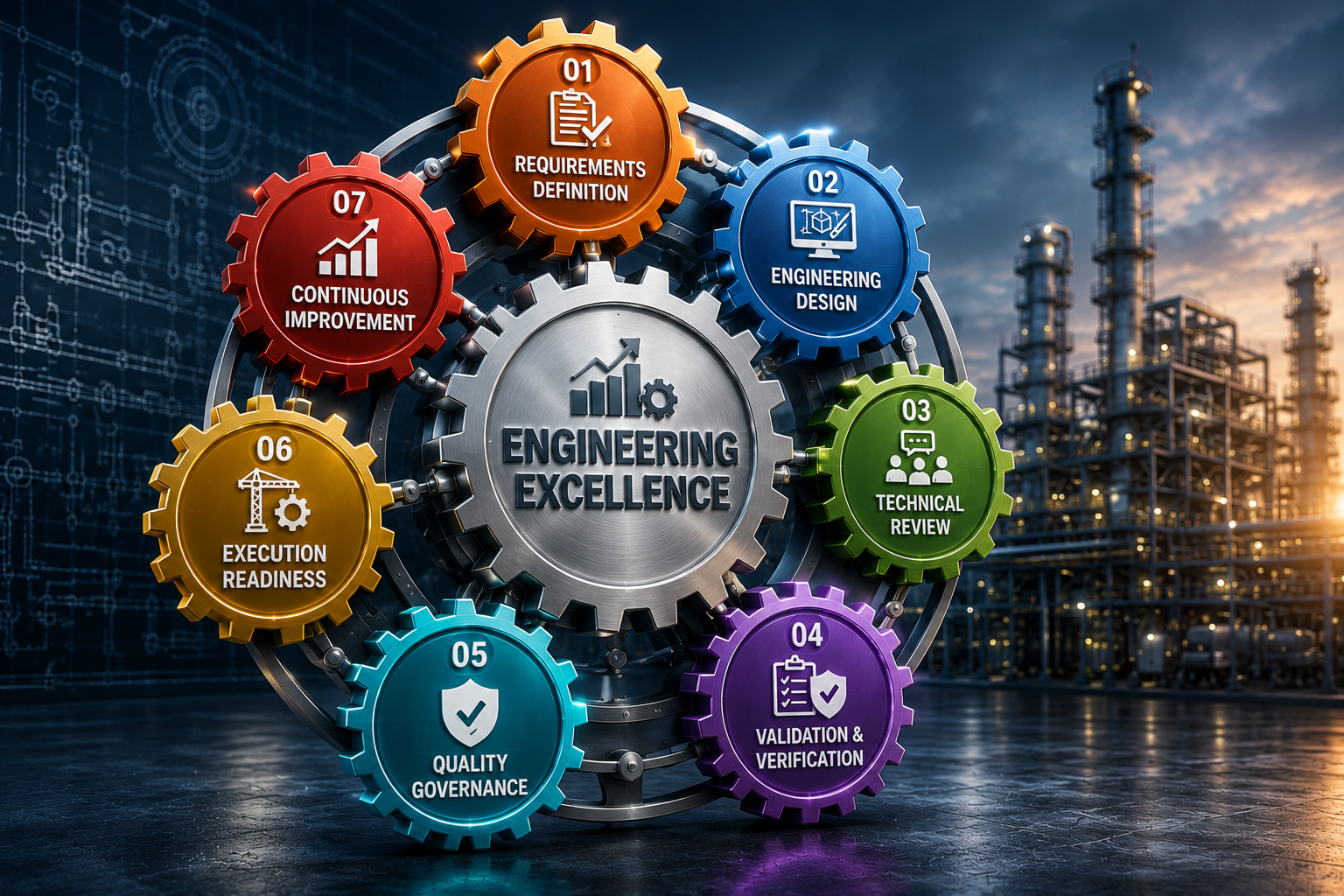
Engineering Excellence Framework Process Disciplines.
Every successful industrial project has one thing in common.
It is not the size of the investment.
It is not the sophistication of the technology.
It is not even the experience of the project team.
The strongest projects are built on a disciplined engineering framework that drives consistency, quality, and execution excellence from concept through commissioning.
Across Oil & Gas, Petrochemical, Refinery, Energy, Water Treatment, Offshore, Marine, and Industrial Manufacturing sectors, leading organizations increasingly recognize that engineering excellence is not an outcome.
It is a process.
Organizations that consistently deliver successful projects follow a structured set of engineering disciplines that help them reduce risk, improve quality, accelerate delivery, and achieve long-term operational reliability.
This framework forms the foundation of engineering excellence.
Why Engineering Excellence Requires More Than Technical Expertise
Many organizations possess talented engineers.
However, technical expertise alone does not guarantee project success.
Without structured engineering processes, organizations often experience:
- Design inconsistencies
- Scope conflicts
- Delayed approvals
- Rework
- Communication gaps
- Cost overruns
- Schedule delays
Engineering excellence emerges when technical expertise is supported by repeatable engineering disciplines.
The most successful organizations create systems that consistently produce high-quality outcomes regardless of project complexity.
Discipline 1: Requirements Definition & Engineering Planning
Every successful project begins with clarity.
The first discipline focuses on understanding:
- Project objectives
- Functional requirements
- Operational expectations
- Performance targets
- Regulatory obligations
- Client requirements
Poorly defined requirements often create downstream problems that become costly to correct.
Organizations that invest time in engineering planning significantly improve project predictability.
Key Outcomes
✔ Clear project scope
✔ Defined technical objectives
✔ Reduced ambiguity
✔ Improved stakeholder alignment
Discipline 2: Engineering Design & Technical Development
Design is where engineering intent becomes reality.
This discipline focuses on developing:
- Engineering calculations
- System architecture
- Process design
- Equipment specifications
- Technical drawings
- Design documentation
Strong engineering organizations establish structured design methodologies that improve consistency across all disciplines.
Why It Matters
A robust design process minimizes errors before they reach execution stages.
Discipline 3: Cross-Functional Technical Reviews
No engineering discipline operates in isolation.
Mechanical decisions impact electrical systems.
Instrumentation influences process performance.
Automation affects operational reliability.
Leading organizations implement structured review mechanisms involving:
- Mechanical Engineering
- Process Engineering
- Electrical Engineering
- Instrumentation Engineering
- Automation & Control Engineering
Technical reviews improve collaboration and identify potential conflicts early.
Benefits
✔ Reduced design clashes
✔ Improved coordination
✔ Better technical decisions
✔ Lower project risk
Discipline 4: Validation & Verification
Engineering quality must be verified before execution.
This discipline ensures that engineering outputs meet intended objectives.
Validation activities may include:
- Design reviews
- Engineering simulations
- Calculation verification
- Performance analysis
- Compliance assessments
- Risk evaluations
Validation provides confidence that the design will perform as intended under real-world operating conditions.
Discipline 5: Quality Assurance & Governance
Engineering excellence requires governance.
Successful organizations establish structured quality systems that ensure:
- Document control
- Revision management
- Approval workflows
- Compliance tracking
- Audit readiness
- Technical accountability
Quality assurance transforms engineering excellence from an aspiration into a repeatable business process.
Governance Creates
✔ Consistency
✔ Accountability
✔ Traceability
✔ Quality confidence
Discipline 6: Execution Readiness & Delivery Support
Engineering work does not end when design is completed.
Execution readiness ensures that engineering deliverables support successful project implementation.
Key focus areas include:
- Construction readiness
- Procurement support
- Vendor coordination
- Installation planning
- Commissioning preparation
Organizations that prioritize execution readiness experience smoother project delivery and fewer implementation issues.
Discipline 7: Continuous Improvement & Knowledge Management
The strongest engineering organizations continuously learn from every project.
Continuous improvement focuses on:
- Lessons learned
- Performance evaluation
- Process optimization
- Technical innovation
- Knowledge retention
Over time, this discipline creates engineering maturity and competitive advantage.
Organizations that systematically improve become stronger with every project delivered.
How These Seven Disciplines Work Together
The true power of engineering excellence lies in integration.
These disciplines are not independent activities.
They function as a connected framework:
Engineering Excellence Framework
Requirements Definition
↓
Engineering Design
↓
Technical Review
↓
Validation & Verification
↓
Quality Governance
↓
Execution Readiness
↓
Continuous Improvement
Each discipline strengthens the next.
Together they create a system that improves project outcomes, reliability, and long-term performance.
Business Benefits of Engineering Excellence
Organizations that implement structured engineering disciplines often achieve:
Operational Benefits
✔ Reduced project risk
✔ Improved engineering quality
✔ Faster decision-making
✔ Better stakeholder alignment
✔ Increased reliability
✔ Reduced rework
✔ Improved delivery timelines
✔ Higher customer confidence
Engineering excellence creates measurable business value beyond technical performance.
Engineering Excellence Is a Competitive Advantage
Industrial organizations operate in increasingly complex environments.
Project success depends on more than technical capability alone.
The most successful organizations develop frameworks that consistently produce reliable outcomes.
Engineering excellence is no longer simply an engineering objective.
It has become a strategic business advantage.
Organizations that master engineering processes, governance, validation, quality, execution, and continuous improvement position themselves for long-term industrial success.
Frequently Asked Questions (FAQs)
- What is an engineering excellence framework? An engineering excellence framework is a structured approach that combines engineering processes, governance, validation, quality assurance, execution readiness, and continuous improvement to improve project outcomes.
- Why is engineering excellence important? It helps organizations reduce risk, improve quality, accelerate project delivery, and increase operational reliability.
- What are the key disciplines of engineering excellence? Requirements definition, design, technical review, validation, governance, execution readiness, and continuous improvement.
- How does engineering excellence reduce project risk? It identifies technical issues earlier and improves decision-making throughout the project lifecycle.
- Does engineering excellence improve delivery timelines? Yes. Structured engineering processes reduce delays, rework, and execution inefficiencies.
- Which industries benefit most from engineering excellence? Oil & Gas, Petrochemical, Refinery, Energy, Water Treatment, Offshore, Marine, Industrial Manufacturing, and Process Industries.
- Is engineering excellence linked to engineering maturity? Yes. Organizations that consistently apply engineering excellence disciplines typically achieve higher levels of engineering maturity.
Why Petronash Engineering?
At Petronash Engineering, engineering excellence is embedded into every project we undertake.
Our engineering methodologies are built around structured processes, governance frameworks, quality systems, validation practices, and continuous improvement principles.
Why organizations choose Petronash Engineering:
- Proven engineering methodologies
- Strong governance and quality frameworks
- Cross-functional engineering expertise
- Focus on risk reduction and reliability
- Execution-oriented engineering support
- Continuous improvement culture
- Engineering approaches aligned with business objectives
- Commitment to delivering measurable industrial outcomes
Ready to Improve Engineering Performance?
Whether you are planning a new project, strengthening engineering governance, or improving execution reliability, our engineering specialists are ready to support your goals.
📩 Email: [email protected]
🌐 Website: www.petronashengineering.com
Partner with Petronash Engineering to build stronger engineering processes, reduce project risk, improve quality, and accelerate industrial project success.