Back To Blogs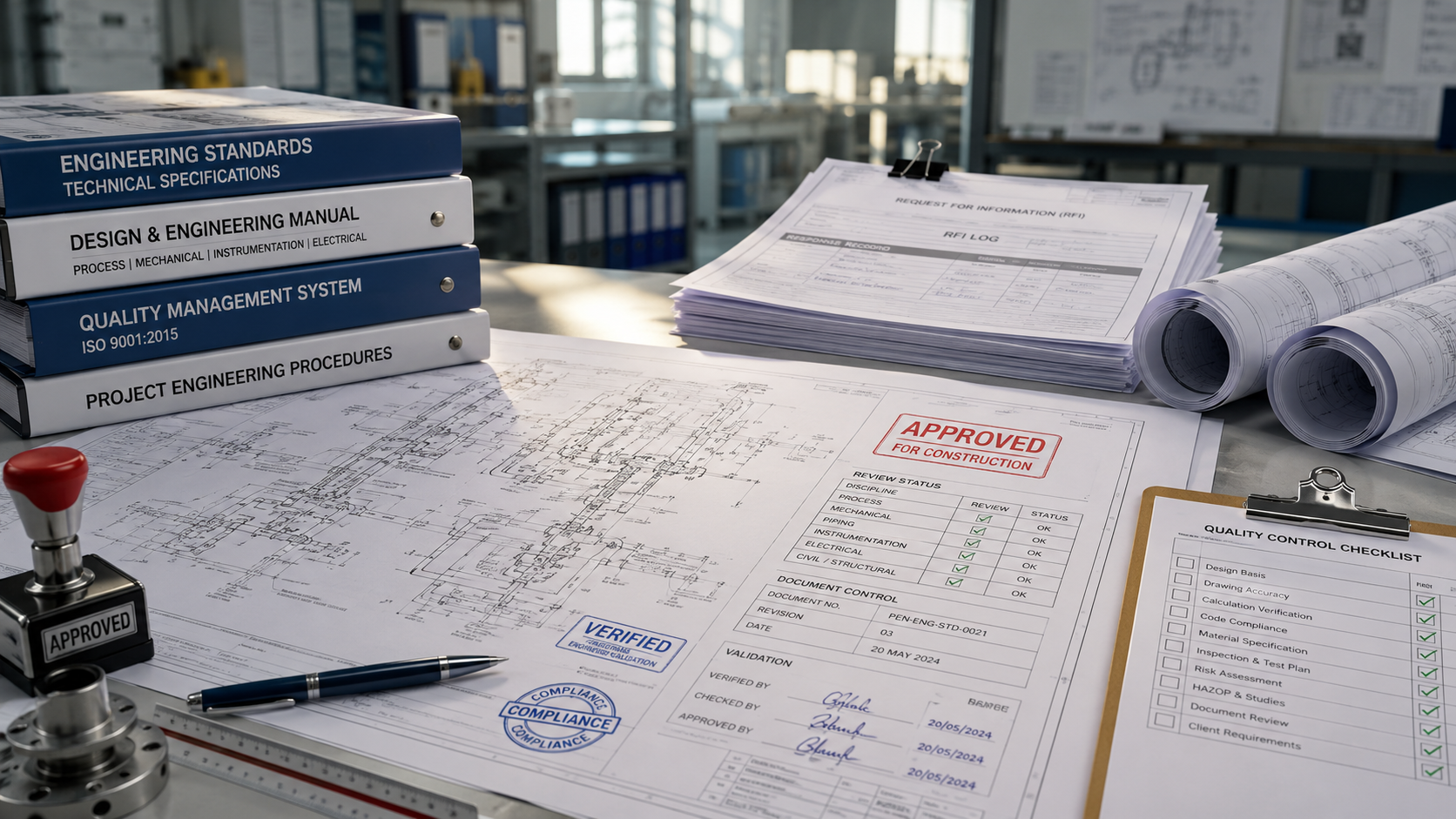
Engineering Standards High Performing Organizations Never Compromise On.
Industrial projects rarely fail because of a single catastrophic mistake.
More often, failures emerge from a series of overlooked engineering decisions, weak technical governance, inconsistent standards, poor documentation control, inadequate validation processes, or execution gaps that compound over time.
Across Oil & Gas, Petrochemical, Refinery, Energy & Power, Water Treatment, Offshore & Marine, and Process Industries, project leaders increasingly recognize a critical reality:
The foundation of project success is established long before construction begins.
It begins with engineering standards.
The strongest engineering organizations understand that standards are not administrative requirements.
They are strategic systems that protect quality, reduce risk, improve predictability, and ensure long-term operational success.
Why Engineering Standards Matter More Than Ever
Industrial projects today are more complex than ever before.
Organizations must manage:
- Multiple engineering disciplines
- Distributed teams
- Complex supplier ecosystems
- Regulatory requirements
- Operational performance expectations
- Asset lifecycle demands
Without structured engineering standards, complexity quickly becomes risk.
High-performing engineering organizations use standards to create consistency, repeatability, and technical confidence across every phase of project delivery.
Engineering standards provide:
✔ Design consistency
✔ Technical reliability
✔ Documentation control
✔ Risk reduction
✔ Regulatory alignment
✔ Long-term maintainability
Standard 1: Structured Engineering Governance
Engineering excellence starts with governance.
Leading organizations establish clear frameworks for:
- Technical accountability
- Design ownership
- Approval authority
- Engineering reviews
- Change management
- Decision documentation
Governance ensures that engineering decisions are measurable, traceable, and aligned with project objectives.
Without governance, technical quality becomes dependent on individuals.
With governance, quality becomes part of the system.
Standard 2: Formal Design Review Processes
Successful engineering organizations never rely on assumptions.
Every major engineering deliverable undergoes structured review.
Critical review stages often include:
Design Review Checkpoints
- Concept Review
- Preliminary Design Review
- Detailed Design Review
- Interdisciplinary Review
- Constructability Review
- Operational Review
These reviews identify risks before they become expensive field problems.
The earlier issues are detected, the lower the cost of correction.
Standard 3: Documentation Control and Revision Management
Many industrial failures originate from outdated or uncontrolled documentation.
High-performing organizations maintain strict controls over:
- Drawings
- Specifications
- Procedures
- Calculations
- Vendor documentation
- Technical correspondence
Effective documentation management ensures:
✔ Version accuracy
✔ Technical consistency
✔ Audit readiness
✔ Reduced execution errors
Engineering discipline begins with document discipline.
Standard 4: Validation and Verification Frameworks
Engineering quality must be proven—not assumed.
Leading engineering teams establish formal validation systems that evaluate:
- Design integrity
- Technical feasibility
- Performance expectations
- System compatibility
- Operational requirements
Validation activities typically include:
- Engineering calculations
- Simulation studies
- Peer reviews
- Compliance assessments
- Performance verification
Verification improves confidence before execution begins.
Standard 5: Cross-Functional Engineering Coordination
Modern industrial facilities operate as integrated systems.
Mechanical systems influence process performance.
Instrumentation affects control reliability.
Electrical infrastructure impacts operational continuity.
High-performing organizations establish coordination frameworks between:
Engineering Disciplines
- Mechanical Engineering
- Process Engineering
- Hydraulic Engineering
- Electrical Engineering
- Instrumentation Engineering
- Automation & Control Engineering
- System Integration Engineering
Integrated engineering reduces conflicts, delays, and rework.
Standard 6: Quality Management and Compliance Alignment
Engineering quality should never be subjective.
Strong organizations implement quality systems that ensure:
- Standardized workflows
- Compliance monitoring
- Technical audits
- Inspection processes
- Continuous quality reviews
Quality management creates consistency across projects regardless of complexity.
It also strengthens client confidence and project predictability.
Standard 7: Continuous Improvement Systems
The best engineering organizations never stop improving.
They actively evaluate:
- Lessons learned
- Technical performance
- Execution efficiency
- Design effectiveness
- Operational outcomes
Continuous improvement helps organizations:
✔ Improve engineering maturity
✔ Reduce recurring issues
✔ Increase project efficiency
✔ Strengthen long-term competitiveness
Engineering excellence is not a destination.
It is an ongoing process.
Why Organizations That Ignore Standards Pay a Higher Price
Some organizations view standards as administrative overhead.
The reality is very different.
The absence of standards often leads to:
- Rework
- Scope conflicts
- Design inconsistencies
- Delayed approvals
- Commissioning challenges
- Operational inefficiencies
- Increased lifecycle costs
What appears to save time initially often creates larger problems later.
Standards reduce uncertainty.
And uncertainty is one of the most expensive risks in industrial projects.
Engineering Excellence Is Built Through Discipline
Industrial leaders increasingly understand that successful outcomes are rarely accidental.
The strongest engineering organizations combine:
✔ Engineering Standards
✔ Governance Frameworks
✔ Structured Reviews
✔ Validation Systems
✔ Quality Management
✔ Continuous Improvement
These capabilities create the consistency required to deliver reliable industrial outcomes.
Engineering excellence is not simply about technical expertise.
It is about creating systems that allow expertise to perform consistently at scale.
FAQs
- What are engineering standards? Engineering standards are structured technical frameworks, procedures, and guidelines that ensure consistency, quality, safety, and reliability throughout engineering projects.
- Why are engineering standards important? They reduce risk, improve quality, strengthen compliance, and increase project predictability.
- How do engineering standards improve project success? They establish repeatable processes that improve design quality, documentation accuracy, validation effectiveness, and execution consistency.
- What role does governance play in engineering? Governance creates accountability, approval structures, quality oversight, and technical decision control.
- Why is documentation control important? Accurate documentation reduces errors, improves traceability, and supports successful project execution.
- How does continuous improvement support engineering excellence? Continuous improvement enables organizations to learn from previous projects and improve future performance.
- Which industries benefit most from engineering standards? Oil & Gas, Petrochemical, Refinery, Power, Water Treatment, Offshore & Marine, Industrial Manufacturing, and Process Industries.
Why Petronash Engineering?
At Petronash Engineering, we believe engineering excellence begins long before execution starts.
Our engineering teams focus on combining technical expertise, governance discipline, quality frameworks, and structured engineering methodologies to create predictable industrial outcomes.
Why organizations partner with Petronash Engineering:
- Engineering approaches built on proven standards and technical governance
- Structured review and validation methodologies
- Strong focus on engineering quality and lifecycle performance
- Cross-functional engineering expertise across industrial disciplines
- Execution frameworks designed to improve predictability and reduce risk
- Continuous improvement mindset focused on long-term value creation
- Engineering capability aligned with business and operational goals
- Commitment to delivering measurable industrial outcomes
Ready to Build Stronger Engineering Foundations?
Whether you are planning a new industrial project, strengthening engineering governance, or improving execution reliability, our engineering specialists are ready to help.
📩 Email: [email protected]
🌐 Website: www.petronashengineering.com
Connect with Petronash Engineering and discover how engineering standards, governance, and technical excellence can improve project outcomes, reduce risk, and create sustainable industrial success.