Back To Blogs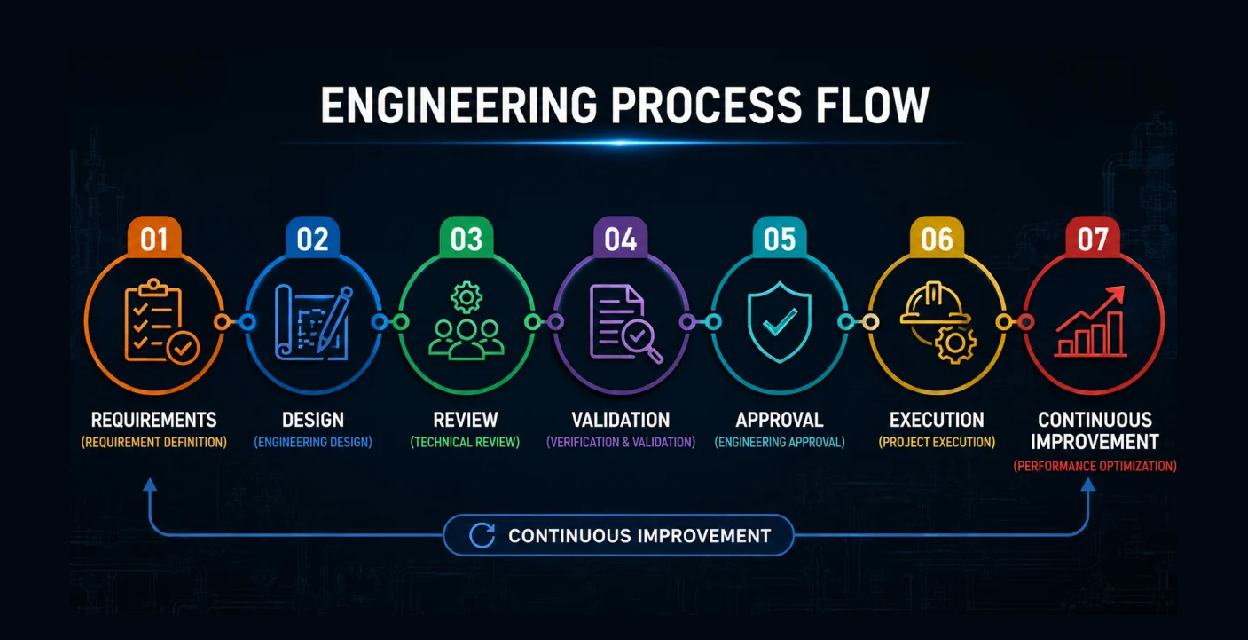
High Performance in Engineering Is Not Accidental
Industrial projects do not succeed because teams work harder.
They succeed because organizations engineer better.
Across global industrial markets, some engineering organizations consistently deliver stronger outcomes.
Projects are executed faster.
Quality remains stable.
Risks are controlled.
Operational performance improves.
The difference is rarely luck.
The difference is usually found in the processes, standards, and execution models behind the organization.
Across Oil & Gas, Petrochemical, Refinery, Energy & Power, Water Treatment, Offshore & Marine, and Process Industries, engineering maturity is becoming one of the strongest indicators of industrial success.
What Makes Engineering Organizations High Performing?
High-performing engineering organizations operate differently.
They do not rely solely on technical expertise.
They combine:
✔ Structured engineering processes
✔ Defined execution models
✔ Technical governance
✔ Cross-functional collaboration
✔ Continuous improvement
✔ Operational accountability
These elements create predictable outcomes at industrial scale.
1. Engineering Processes Create Execution Discipline
Strong organizations do not reinvent execution for every project.
They establish repeatable engineering systems.
Typical engineering processes include:
Engineering Process Areas
- Requirement definition
- Technical planning
- Design reviews
- Validation cycles
- Change management
- Documentation governance
- Quality checkpoints
- Engineering approvals
Process discipline improves consistency.
2. Engineering Standards Build Technical Confidence
Standards reduce uncertainty.
Engineering organizations increasingly establish frameworks that improve:
- Technical quality
- Design consistency
- Compliance readiness
- Documentation quality
- Safety alignment
- Engineering repeatability
Standards allow industrial growth without sacrificing quality.
3. Execution Models Improve Delivery Predictability
Execution models determine how engineering transforms into outcomes.
High-performing organizations commonly focus on:
Execution Components
- Planning methodology
- Stage-gate execution
- Cross-functional reviews
- Interface management
- Risk governance
- Resource alignment
Execution models improve project confidence.
4. Governance Turns Engineering into Business Performance
Governance ensures engineering remains measurable.
Industrial organizations increasingly evaluate:
- Accountability structures
- Technical ownership
- Engineering reviews
- Quality reporting
- Decision frameworks
- Continuous monitoring
Governance creates industrial reliability.
5. Collaboration Improves Engineering Performance
Engineering is no longer siloed.
High-performing engineering environments strengthen collaboration across:
- Mechanical Engineering
- Hydraulic Engineering
- Electrical Engineering
- Instrumentation Engineering
- Process Engineering
- Automation & Control Engineering
- System Integration
Better collaboration improves execution outcomes.
6. Engineering Quality Creates Long-Term Value
Industrial value extends beyond project delivery.
Engineering quality influences:
✔ Reliability
✔ Maintainability
✔ Operational continuity
✔ Asset performance
✔ Lifecycle efficiency
Quality becomes a long-term growth driver.
7. Continuous Improvement Sustains Competitive Advantage
The strongest engineering organizations continuously evolve.
Continuous improvement supports:
- Faster engineering cycles
- Better technical decisions
- Improved operational performance
- Higher execution maturity
- Industrial scalability
Organizations that improve continuously remain competitive.
Engineering Maturity Is Becoming a Strategic Asset
Industrial leaders increasingly understand:
Technology can be purchased.
Infrastructure can be expanded.
But engineering maturity must be built.
Organizations that strengthen:
Processes + Standards + Execution + Governance
create stronger business outcomes.
Engineering excellence is becoming a measurable competitive advantage.
FAQs
- What defines a high-performing engineering organization?
A high-performing engineering organization combines structured processes, technical standards, governance, execution discipline, and continuous improvement. - Why are engineering standards important?
Standards improve consistency, quality, compliance, and project predictability. - How do execution models improve outcomes?
Execution models improve planning, coordination, accountability, and delivery performance. - Why does governance matter in engineering?
Governance ensures quality control, decision accountability, and execution consistency. - How does collaboration improve engineering delivery?
Cross-functional collaboration reduces technical conflicts and strengthens project performance. - What role does continuous improvement play?
Continuous improvement helps engineering organizations remain efficient and competitive. - Which industries benefit from engineering maturity?
Oil & Gas, Petrochemical, Refinery, Energy, Water Treatment, Offshore & Marine, and Process Industries.
Why Petronash Engineering?
Engineering performance should not depend on individual effort alone.
It should be supported by structured systems, technical discipline, and execution maturity.
At Petronash Engineering, we focus on creating engineering environments that combine process strength with practical industrial execution.
Why organizations work with Petronash Engineering:
✔ Execution frameworks designed for predictable industrial outcomes
✔ Engineering engagement built around process maturity and accountability
✔ Structured delivery approaches that improve execution confidence
✔ Focus on engineering quality across every project stage
✔ Collaborative execution models that improve technical alignment
✔ Continuous improvement mindset that supports long-term value creation
✔ Governance-driven engineering approaches for industrial reliability
✔ Commitment to converting engineering excellence into business performance
Ready to Strengthen Engineering Performance?
Whether you are improving engineering maturity, scaling execution capability, or creating stronger industrial outcomes — our engineering experts are ready to support your goals.
📩 Email: [email protected]
🌐 Website: www.petronashengineering.com
Connect with Petronash Engineering and explore how stronger engineering processes and execution models can improve project performance and long-term industrial success.