Back To Blogs
Chemical dosing plays a vital role in keeping oil and gas operations safe, efficient, and reliable. From controlling corrosion to improving water treatment and preventing foam, the right chemical treatment protects equipment and maintains stable production.
But effective treatment is not just about choosing the right chemical. Accurate dosage, proper injection, and continuous monitoring are equally important.
Poorly designed chemical injection systems can lead to higher operating costs, equipment damage, unstable processes, and unnecessary chemical consumption.
Understanding how different chemicals work, and how they should be delivered, is the first step towards better process performance.
Why Chemical Selection Matters
Every oil and gas facility operates under different conditions. Fluid composition, temperature, pressure, flow rate, and water chemistry all influence chemical performance.
A treatment that works well in one facility may not deliver the same results elsewhere.
Before selecting a chemical, engineers need to understand the process problem, identify its root cause, and define the expected treatment outcome.
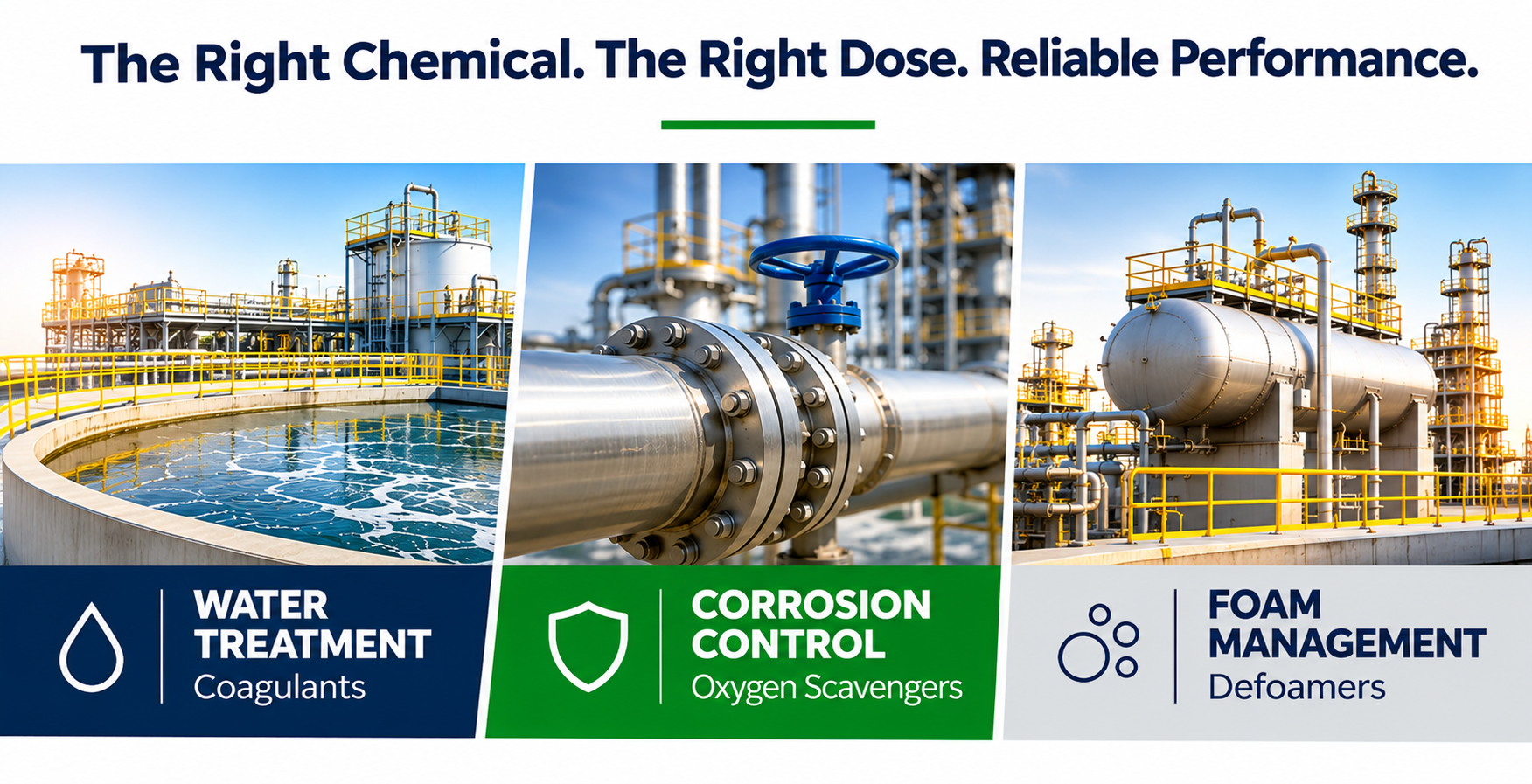
Three commonly used treatment chemicals are coagulants, oxygen scavengers, and defoamers.
1. Coagulants: Improving Water Treatment
Produced water and industrial wastewater often contain fine suspended particles and dispersed oil that are difficult to separate.
Coagulants help these particles come together, forming larger clusters that can be removed more easily through flotation, clarification, or filtration.
Key benefits include:
- Improved removal of suspended solids and dispersed oil
- Better water clarity and treatment performance
- More efficient downstream separation
The correct dosage depends on water chemistry, pH, temperature and the type of contamination.
Overdosing can increase sludge formation, affect filtration and raise operating costs. Laboratory testing and field monitoring help determine the most effective dosage.
2. Oxygen Scavengers: Protecting Against Corrosion
Dissolved oxygen is a major concern in water-handling systems. Even small amounts can accelerate corrosion in pipelines, vessels, tanks, and water injection equipment.
Oxygen scavengers react with dissolved oxygen, helping reduce its concentration and protect equipment from corrosion.
For effective treatment, engineers must consider water flow, oxygen concentration, chemical reaction time, temperature, and injection location.
Key benefits include:
- Reduced risk of oxygen-related corrosion
- Better protection of pipelines and equipment
- Improved long-term system reliability
Regular monitoring of dissolved oxygen, chemical residuals, and corrosion indicators is essential. Increasing the chemical dose alone may not solve problems caused by poor mixing or oxygen entering the system downstream.
3. Defoamers: Maintaining Stable Production
Excessive foam can disrupt oil and gas processing, particularly in separators, gas treatment systems, and dehydration units.
Foaming may cause unstable level readings, liquid carryover, and reduced processing capacity.
Defoamers help break down foam and restore more stable operating conditions.
Key benefits include:
- Improved gas-liquid separation
- Reduced liquid carryover
- More stable equipment operation
Choosing the right defoamer depends on the fluid composition, operating temperature, pressure, and compatibility with downstream processes.
The objective is to use the lowest effective dosage. Excessive treatment can create separation or product-quality problems.
Why Accurate Chemical Dosing Is Critical
Even the right chemical can fail when the injection system delivers an incorrect or inconsistent dosage.
An effective chemical injection system should maintain accurate dosing across changing process conditions.
Key engineering considerations include:
- Metering accuracy: Delivering the required chemical quantity consistently.
- Injection location: Ensuring proper mixing and sufficient reaction time.
- Material compatibility: Protecting pumps, valves, seals and piping from chemical damage.
- Automation: Adjusting dosing rates when process conditions change.
- Monitoring: Detecting pump failures, low chemical levels, and abnormal pressures.
Chemical injection packages may include storage tanks, metering pumps, calibration systems, pressure protection, instrumentation, and automated controls.
A properly engineered package brings these elements together to support reliable and safe chemical delivery.
How Petronash Supports Reliable Chemical Injection
With over 25 years of experience in engineered oil and gas packages, Petronash designs and manufactures chemical injection systems suited to specific process requirements.
Our engineering approach considers chemical properties, dosing accuracy, operating pressure, system reliability, and ease of maintenance.
Petronash's multidisciplinary engineering capabilities support conventional, multipoint, PLC-controlled, solar-powered, offshore, and low-temperature chemical injection packages.
From engineering and design to manufacturing, testing, and commissioning, the focus is on delivering systems that operate reliably under real process conditions.
Frequently Asked Questions
1. How is the correct chemical dosing rate determined?
The rate is based on process flow, fluid properties, treatment objectives, chemical concentration, and laboratory testing. Field validation helps confirm the final dosage.
2. What happens when chemicals are overdosed?
Overdosing increases chemical costs and may cause separation problems, unwanted deposits, or downstream process issues.
3. Why is injection location important?
The right injection point allows the chemical to mix properly with the process fluid and provides sufficient time for the treatment to work.
4. Can chemical injection systems be automated?
Yes. Automated systems can adjust dosing based on process flow, analyzer readings, or control-system signals, improving consistency and operational control.
Improve Process Reliability with Petronash
Effective chemical treatment begins with proper engineering. The right chemical, accurate dosing and a reliable injection system work together to protect equipment and maintain process performance.
Whether your project requires a new chemical injection package or an upgrade to an existing system, Petronash can help develop a solution suited to your operating requirements.
Discuss your chemical injection requirements with our engineering team.
Email: [email protected]
Website: www.petronashengineering.com